Trump Removes Mike Waltz as National Security Advisor Amid "Signalgate" Controversy
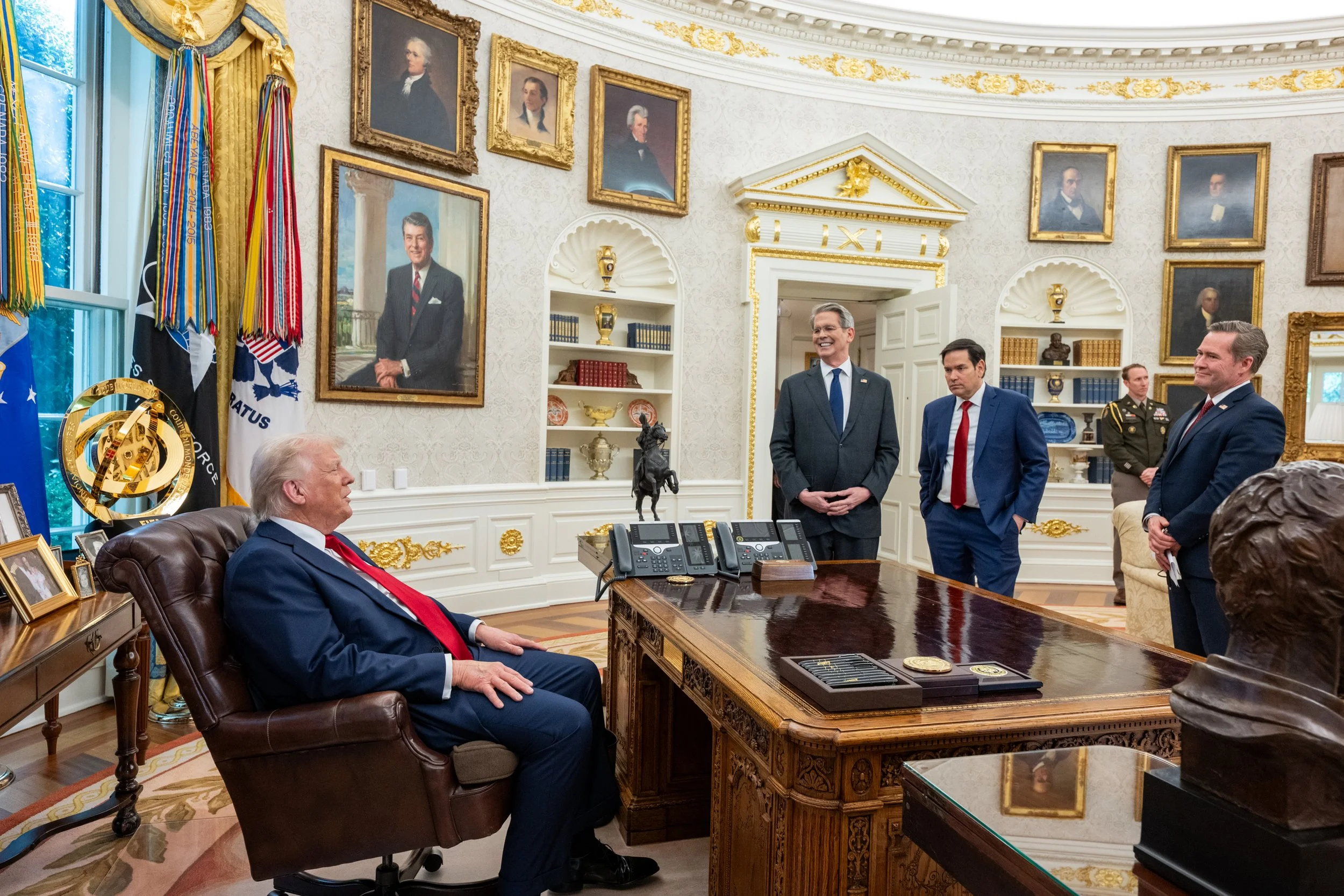
President Donald Trump speaks with Secretary of Commerce Scott Bessent, Secretary of State Marco Rubio, and National Security Advisor Mike Waltz in the Oval Office, Wednesday, April 30, 2025. (Official White House Photo by Molly Riley)
Mike Waltz has been removed as National Security Advisor following a security breach involving sensitive information on the messaging platform Signal, sparking speculation about his replacement amid shifting U.S. foreign policy priorities.
Article by Stella Smith, Associate White House Correspondent
WASHINGTON - On Thursday, May 1st, President Trump removed Mike Waltz as acting National Security Advisor (NSA), appointing Secretary of State Marco Rubio to take over the role until a permanent advisor is selected. This move follows the ongoing controversy surrounding what has been dubbed “Signalgate,” an incident in which Waltz reportedly mishandled sensitive information on the encrypted messaging platform.
According to multiple reports, Waltz was texting in a Signal groupchat which included senior defense and intelligence officials when he mistakenly added journalist Jeffrey Goldberg, editor-in-chief of The Atlantic, to the conversation. This chat included references to classified U.S. operations in Yemen which were not intended for public disclosure.
Though Goldberg did not publish any of the material and reportedly exited the chat within minutes, the incident triggered internal investigations and raised serious concerns about operational security under the Trump administration.
While President Trump has not explicitly stated that this incident was the reason for Waltz’s removal, many speculate that the timing and nature of this controversy played a role in the decision to dismiss him from the National Security Council.
Prior to Waltz’s removal, President Trump announced he would be nominating the former National Security Advisor to be the next US Ambassador to the United Nations. On Truth Social, he wrote, “Mike Waltz has worked hard to put our Nation’s Interests first. I know he will do the same in his new role.”
Separate reports claim that Waltz also upset President Trump after engaging in “intense coordination” with Israeli Prime Minister Benjamin Netanyahu regarding military strikes in Iran, which could have contributed to the decision to remove him from his position. Netanyahu’s office, however, denied these claims.
Speculation about who will permanently replace Waltz has already begun, with several high-profile names being discussed as potential candidates. One possible replacement is President Trump’s current Special Envoy to the Middle East, Steve Witkoff, who has served as a top U.S. negotiator with Russia amid the war in Ukraine. Another potential option is Ric Grenell, the former U.S. Ambassador to Germany and former Director of National Intelligence under President Trump’s first administration.
All things considered, the selection of Waltz’s permanent successor will undoubtedly shape the direction of U.S. foreign policy, especially considering ongoing tension with Russia over Ukraine, escalating concerns regarding Iran’s nuclear ambitions, and the shifting dynamics in the Middle East.