Eleven Years Later, Andrew McKeough Finds His Edge Again
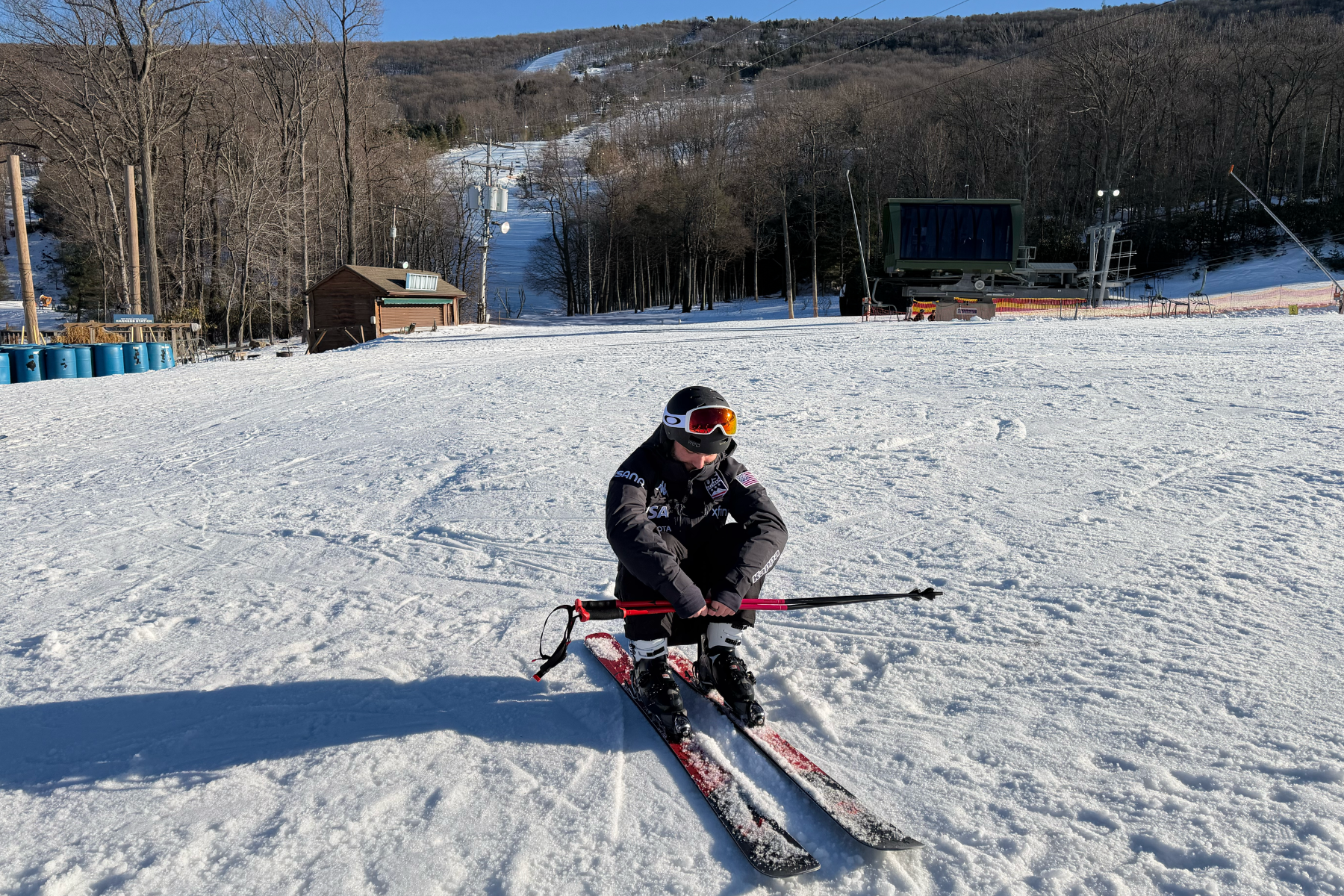
Andrew Mckeough takes a moment to take in the feeling after completing his first downhill since an accident in 2015 almost ended his career. (Photo courtesy of AKSM Sports)
After eleven years, Andrew McKeough has conquered the ghosts of his 2015 crash by as he returns to the slopes that ended his career.
Article by Dave Nguyen, AKSM Sports Editor
TANNERSVILLE, Pa. - The sound of a ski edge carving through hard-packed powder is a symphony for some, but for Andrew McKeough, it was a sound he once feared he would never hear again, at least not from the perspective of the skis.
Eleven years ago, in early March of 2015, the snow sports community watched as a catastrophic crash on the slopes threatened to end McKeough’s athletic pursuits permanently. The accident was a visceral reminder of the thin line between peak performance and life-altering injury.
Today, under the crisp blue skies of the Camelback slopes, that line has been rewritten.
Following the 2015 accident, McKeough’s focus shifted. While the physical injuries healed, the psychological ghosts of the mountain remained. He spent the intervening decade building a formidable career behind the lens of a camera, documenting history from the halls of the White House to the sidelines of major sporting events.
But friends say the mountain never truly left him.
"For a long time, Andrew was content being the observer," says long-time friend Angel Wolf. "He channeled his adrenaline into photojournalism. But there’s a difference between capturing the speed and feeling it. This winter, he decided it was time to feel it again."
McKeough’s return to skiing has been a calculated, quiet process. Eschewing the fanfare that often accompanies comeback stories, he began training in early 2025, working with specialized coaches to recalibrate his technique and, more importantly, his confidence. He finally got the clearance to return to the slopes from his medical team in January with Dr. Sharon Barone, a member of McKeough’s medical team who has worked with him since his accident in 2015, stating that, “[…] his spine is stable.” A victory that had been postponed numerous times since 2021 when McKeough first floated the idea of returning to the slopes.
While talking about how athletes overcome their injuries, McKeough said that, “Seeing Mikaela [Shiffrin] navigate the psychological 'grief fog' of her recent injuries, and witnessing Lindsey [Vonn]’s devastating crash in the downhill [at the 2026 Milan Cortina Olympic Winter Games], felt like a mirror held up to my own past.” He added that, “My return to the slopes this month is, in many ways, a tribute to that shared struggle. We see these athletes as superheroes, but their real power isn't in their speed: it’s in their refusal to let a single moment of impact define the rest of their lives.”
Sarah Smoll returned as McKeough’s senior equipment specialist and said that McKeough also hit the mountain with a new slate of state-of-the-art equipment including German-made VÖLKL M7 Mantraa skis from Völkl’s 2026 collection, paired with REDSTER GS SQS poles from Atomic’s 2026 race collection, Hawx Ultra 110 S GW ski boots from Atomic’s 2025 collection and - most importantly - Pivot 2.0 15 GW ski bindings from Look’s 2026 collection. Smoll included that the decision to go with Look’s Pivot 2.0 was a calculated one, stating that, “[Pivot 2.0] represents the pinnacle of protective engineering. Its iconic turntable heel is designed to rotate directly under the tibia, providing a level of multi-directional release that is essential for a skier with Andrew’s history.”
Witnesses at Camelback Mountain this week saw a skier who wasn’t just "getting by." McKeough looked fluid, aggressive, and, most importantly, at peace while, at times, reaching speeds of 50 miles-per-hour.
"The 2015 crash was a defining moment of my youth," McKeough said briefly between runs on Saturday. "It taught me respect for the mountain. Returning now, in 2026, isn't about proving I can still go fast. It’s about proving that the things that break us don’t have to keep us broken."
In 2015, the story was about the fall. In 2026, the story is about the perspective gained from the climb back to the sport.
As he got older, McKeough has often spoken about the "persistence of vision." This week, that vision was fixed firmly on the horizon of a downhill run. While he may no longer be the reckless youth of a decade ago, the skier who emerged from the lodge this March is faster in all the ways that count: wiser, stronger, and finally, home.
McKeough says he plans to return to Bear Creek, the same mountain that caused his accident, starting tomorrow for intensive training in preparation for the 2026/2027 season where he plans to start with NASTAR races and training for the 2027 Vertical Challenge racing series while coaching during his first full season back on the mountain.
When asked if he had any apprehension about the eleven-year anniversary of the crash, during a season where he could have been competing in the Milan Cortina Winter Olympics, McKeough looked up at the summit and smiled.
"The mountain is still there," he said. "The only thing that’s changed is me."