Tragedy on the Slopes as McKeough's Career Sidelined by Freak Equipment Failure
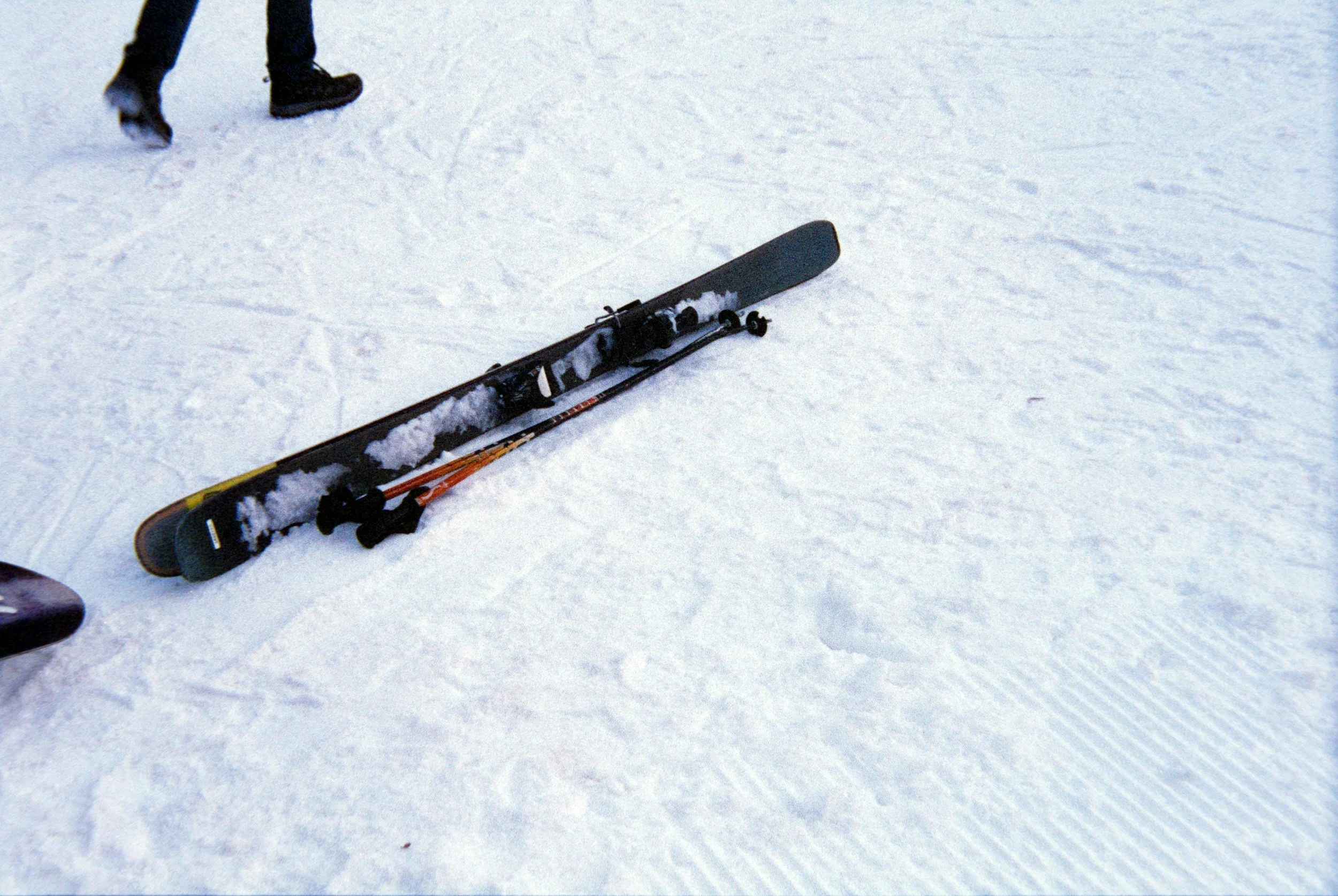
The technical investigation is currently scrutinizing a potential “Houdini release," where extreme ski flex under high G-forces may have caused the boot to lose contact with the binding despite the mechanism remaining closed, highlighting a critical vulnerability in modern high-DIN speed equipment. (Spencer Plouzek/Unsplash)
Professional speed skier Andrew McKeough’s career has been put on hold following a catastrophic binding failure during a high-speed jump that resulted in a severe herniation and debilitating sciatic nerve damage.
Article by Maddie Tyler, Junior Sports Reporter
MACUNGIE, Pa. - The high-octane world of professional alpine speed skiing is a game of inches and milliseconds, but for eighteen year-old Andrew McKeough, a split-second mechanical failure has turned a quest for the podium into a grueling road to recovery.
During a high-speed training run on Saturday afternoon, McKeough - who is set to start at Villanova University in the fall - suffered a catastrophic equipment failure that resulted in a season-ending, and potentially career-threatening, spinal injury.
Witnesses say McKeough was hitting the a “big air” section of the Cascade course at speeds clocking near 60 mph. As he compressed into the takeoff of a major jump, his bindings reportedly sheared under the immense G-force and exploded mid-air.
Without the stability of his skis to balance his landing, McKeough was sent into a violent tomahawk tumble down the icy pitch. Emergency crews reached the athlete within minutes, stabilizing him on the mountain before he was rushed to Lehigh Valley Hospital - Cedar Crest, a Level I specialized trauma center in Allentown, Pennsylvania.
Medical reports released this morning confirm the severity of the impact. The force of the landing caused a “significant herniation of the L4/L5 vertebral discs.”
The structural damage led to an immediate and severe pinching of the sciatic nerve, a condition that often results in debilitating pain and loss of motor function in the lower extremities.
"In speed skiing, your equipment is your lifeline," said veteran coach Marcus Thorne. "To have a binding fail at those speeds is every racer's worst nightmare. Andrew is a fighter, but this isn't just a rupture, it’s a neurological challenge."
McKeough is currently under the care of top spinal surgeon Dr. Robert Ruggiero Jr. from Premier Orthopaedics & Sports Medicine at their Pennsylvania Orthopaedic Center Division. The immediate focus remains on reducing inflammation around the L4/L5 region to alleviate the pressure on his sciatic nerve.
While the skiing community rallies around the young speedster, questions regarding equipment safety and the limits of modern binding tension (DIN) settings are already beginning to circulate among technical delegates.
The focus of the alpine racing community will soon shift to the technical "why." Yesterday, a forensic team of equipment engineers and FIS (International Ski Federation) technical delegates began a deep-dive investigation into the catastrophic binding failure that sent McKeough into that high-speed tomahawk tumble.
In the professional circuit, athletes often use World Cup bindings with DIN settings (the standardized scale for release force) far exceeding those available to the public. While a typical expert skier might set their DIN at 10 or 11, pro racers often crank their settings to 18 or higher to prevent "pre-release"—the nightmare scenario where a ski pops off due to vibration rather than a crash.
Initial reports suggest that McKeough did not suffer a standard "pre-release." Instead, the investigation is focusing on two critical technical theories:
The "Flex Effect": As McKeough compressed into the takeoff, the extreme G-force caused his skis to flex into a deep arc. If the binding’s forward pressure mechanism (which allows the heel piece to slide back and forth as the ski bends) became "sluggish" or hit its mechanical limit, the distance between the toe and heel pieces may have widened just enough for the boot to slip out without the binding actually "releasing."
Shear Failure: Investigators are examining the metal housing of the toe piece. There is speculation that the sheer velocity and the specific angle of the jump caused a structural failure in the binding’s internal springs or the screws anchoring the unit to the ski plate.
One of the most baffling aspects of the crash was that McKeough's heel piece was reportedly found in the closed position after the accident.
"When the heel remains closed but the skier is gone, we call it a 'Houdini' release," explained McKeough’s equipment specialist Sarah Smoll. "It usually points to an issue with forward pressure. The ski flexes, the boot loses contact, and the binding snaps back shut as if nothing happened. At the speeds professionals go, that 'ghost' release is a death sentence for your balance."
The technical failure had a direct physical consequence. The abrupt ejection while the body was under peak compression resulted in a "vertical load" injury.
For a speed skier, the L4/L5 region is the "power station" for core stability and edge control. McKeough’s medical team is currently debating between conservative management and a microdiscectomy (a surgical procedure to remove the portion of the disc pressing on the nerve).
Whether through conservative physical therapy or the precision of a microdiscectomy, the path forward will require the same grit that defined his descent down the mountain. While his future on the speed circuit remains an open question, the skiing community waits with bated breath, reminded once again of the razor-thin margin between a world-class performance and a life-altering accident.