Europe Pushes Back as Trump Presses for Control of Greenland
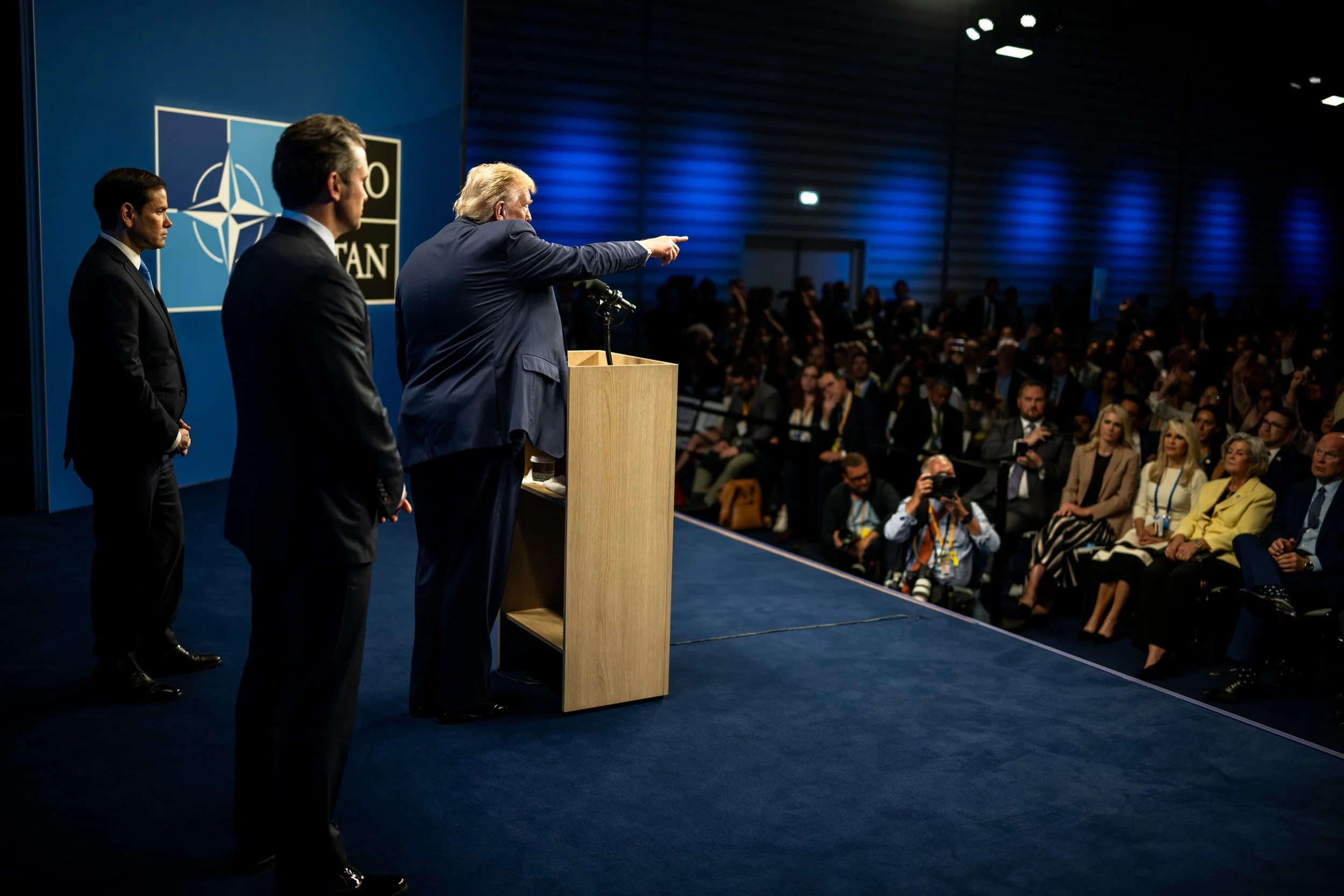
President Donald Trump participates in a press conference, Wednesday, June 25, 2025, during the 2025 NATO Summit at the World Forum in The Hague, Netherlands. (Official White House Photo by Daniel Torok)
As tariff threats and diplomatic pressure from Washington prompt European allies to rally behind Denmark, the strategic Arctic island emerges as a new point of tension between the United States and Europe.
Article by Stella Smith, White House Digital Director
WASHINGTON - The standoff between the U.S. and Denmark over the future of Greenland entered a new phase this week, as President Trump threatened to impose tariffs on U.S. allies who refuse to support his bid for control of the Arctic territory. The move alarmed European nations and drew immediate objection from Denmark, which maintains sovereignty over Greenland.
As a semi-autonomous part of the Kingdom of Denmark, Greenland occupies one of the most strategically valuable positions on the globe. The island sits at the center of the GIUK gap – the maritime point between Greenland, Iceland, and the United Kingdom that links the Arctic Ocean to the North Atlantic, serving as a key surveillance corridor for NATO. The territory also holds substantial untapped oil and gas reserves, as well as some of the world’s most coveted rare earth minerals.
In remarks to reporters, President Trump framed the issue as a matter of national security, arguing that U.S. control of the island is essential to counter Russian and Chinese activity in the Arctic. European officials, however, warned that coercive economic tactics against allies would mark dangerous escalation. On Tuesday, Denmark’s foreign ministry issued a statement asserting sovereignty over Greenland is “not for sale, not negotiable, and not subject to pressure.”
Diplomacy continued in Washington on Jan. 14th, when Denmark’s top diplomat Lars Løkke Rasmussen and Greenland’s foreign minister Vivian Motzfeldt met with Vice President JD Vance and Secretary of State Marco Rubio. U.S. officials described the discussions as candid and productive, noting that both sides agreed to establish a working group on Arctic security. Danish representatives reiterated that existing NATO arrangements are sufficient to protect the region and that any attempt to redraw control over Greenland would face firm resistance.
The White House campaign has also faced pushback on Capitol Hill. A bipartisan group of lawmakers has criticized the tariff threats and argued that long-standing cooperation with Denmark already serves U.S. interests. Several members of Congress traveled to Copenhagen earlier this month, reassuring Danish and Greenlandic leaders that much of Congress remains committed to alliance norms and does not support annexation.
Meanwhile, European allies have made a tangible show of support for Denmark. France, Germany, the UK, Norway, and Sweden have sent troops and military planners to Greenland under NATO coordination, deployments intended to demonstrate alliance solidarity and to signal that a collective security framework can safeguard the Arctic.
Whether the tariff threats will be carried out remains uncertain, but the dispute has widened rifts within NATO and introduced new uncertainty into the geopolitics of the Arctic. For now, the future of Greenland has become an unexpected point of contention between allies at a moment of intensified global competition.